
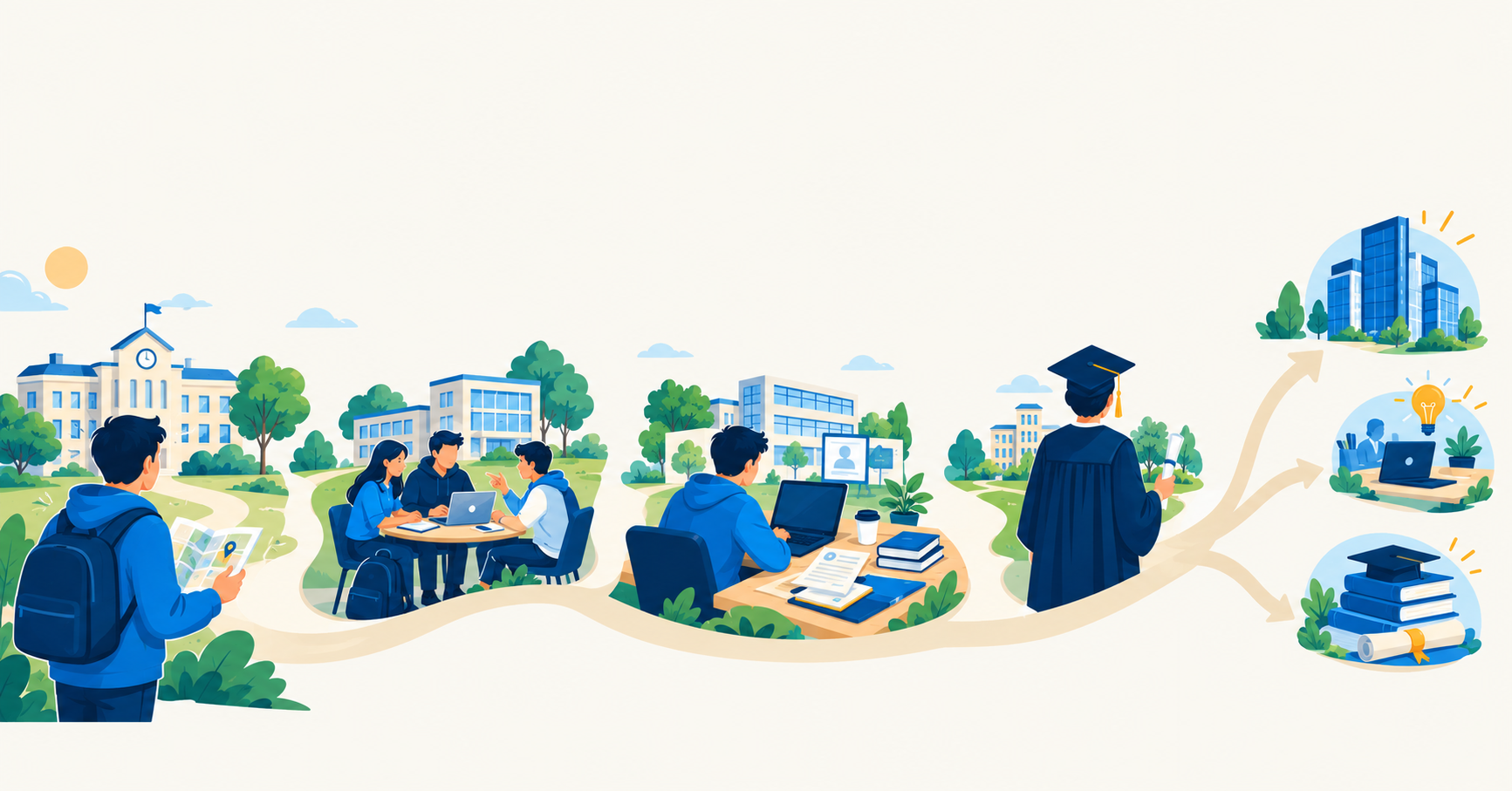
Four years that change you more than you expect
Nobody walks out of college the same person who walked in. Between the first nervous day and the farewell, you learn how to manage money, time, friendships, failure and your own mind. This is the story of that journey, year by year, and where it leads.First year: new city, new freedom, new confusion
Everything is new: the classroom, the hostel or the daily commute, the people, even how you are expected to study. Many students feel excited and lost at the same time.What drives you: curiosity, the joy of independence, and the wish to make friends and prove yourself.
What to do: attend classes, build a study routine early, try two or three clubs or events, and don't compare your starting point with anyone else's. Collecting good notes for each subject from day one saves stress later, and the Notes page can help.
Common trap: treating the first year like a holiday and paying for it later with backlogs.
Second year: finding your people and your direction
By now you know the campus. Friendships settle, subjects get harder, and you start to see what you actually enjoy.What drives you: interest in a particular subject, seniors who inspire you, and the first real competition for marks and opportunities.
What to do: pick one skill and learn it properly, such as coding, design, writing or public speaking. Join a club or team where you do real work, not just attend meetings. Start small projects.
Common trap: drifting along with the crowd without deciding what you want to be good at.
Third year: the pressure begins
Internships, placement talk and exam stress all arrive together. This is the year many students feel behind, whether they really are or not.What drives you: fear of missing out, but also a clearer goal. For many students, a first internship or project makes the future feel real.
What to do: apply for internships, build one or two projects you can explain, and practise problem solving regularly. Keep your marks steady, since many companies and colleges ask for them. The Blogs page has guides on balancing exams and placement prep.
Common trap: measuring your progress against the loudest person in the group.
Final year: decisions, goodbyes and uncertainty
Projects, placement drives, entrance exams, startup ideas and family expectations all pile up, and everything feels urgent. At the same time, you realise how little time is left with the friends you grew up with.What drives you: a sense of responsibility, the wish to make your family proud, and the excitement of starting something new.
What to do: prepare well for interviews, but know your other options too. Not getting selected in the first drive is not the end. Thank the teachers and seniors who helped you, and keep in touch with your friends.
Common trap: believing that one result decides your whole life.
Staying motivated through all four years
Motivation rises and falls. Students who keep going usually do a few simple things:Set small goals for the week, not only big ones for the year.
Find a circle of friends who push each other to improve.
Learn from failure. A bad semester or a rejected application teaches more than an easy win.
Look after yourself. Sleep, food and breaks from screens matter as much as study hours.
Remember your why. Write down why you chose this course and read it on tired days.
How college shapes the person you become
Graduation is more than a degree. By the end, most students have grown in ways marks can't show. They are more responsible, can handle pressure, speak up for themselves, treat people with respect and know how to ask for help. That change into a mature, dependable person is the real result of four years on campus.After graduation: many roads, none of them wrong
The job route. Many graduates join a company, learn how work really happens and build a career step by step. The first job is a starting point, not a final label.The founder route. Some start a business or a product, often with friends from college. It is risky and takes patience, and many early ideas change or fail before one works. The skills it needs, like teamwork, explaining an idea and handling uncertainty, often start on campus.
Higher studies. Some go for a master's degree, research or a competitive exam because they want depth in one field.
The career switchers. Many graduates end up in a field different from their degree: an engineer who moves into design, writing or finance, or a commerce graduate who learns to code. They usually do it by learning a skill alongside work, building a small portfolio and being willing to start a step lower for a while. Changing direction does not waste your degree, because the habits you built still come with you.
A few things to remember
Your timeline is yours. Some people get a job in the final year, others a year after college, and others find their path much later. Marks matter, but so do skills, kindness and consistency. The friends you make in college often become your most important network.Four years pass quickly. Study well, try new things, be kind, and leave college a better person than you entered it.
Comments (0)
No comments yet
Be the first to share your thoughts and start the discussion.